
- chronextechnologies
- January 20, 2021
1. Why “Think Data, Think AI”?
Most failed AI projects don’t fail because of bad algorithms. They fail because of:
-
Messy, incomplete, or inconsistent data
-
Data scattered across systems and silos
-
No governance, no ownership, no trust in numbers
-
No clear link between data and business goals
“Think Data, Think AI” is a mindset shift:
-
Don’t start with: “Which model should we use?”
-
Start with: “Do we have the right data, in the right shape, to solve this problem?”
If your data is poor, even the best AI becomes:
-
Biased
-
Unreliable
-
Hard to explain
-
Impossible to maintain in production
Good data doesn’t guarantee success — but bad data almost guarantees failure.
2. Data First: The Real Fuel of AI
Before we go deeper, let’s clarify:
-
Data = Raw facts and events (transactions, clicks, sensor readings, text, images, logs, etc.)
-
Information = Data with context and structure
-
Insights = Useful information that informs decisions
-
AI = A system that learns from data and produces predictions, recommendations, or actions
The flow looks like this:
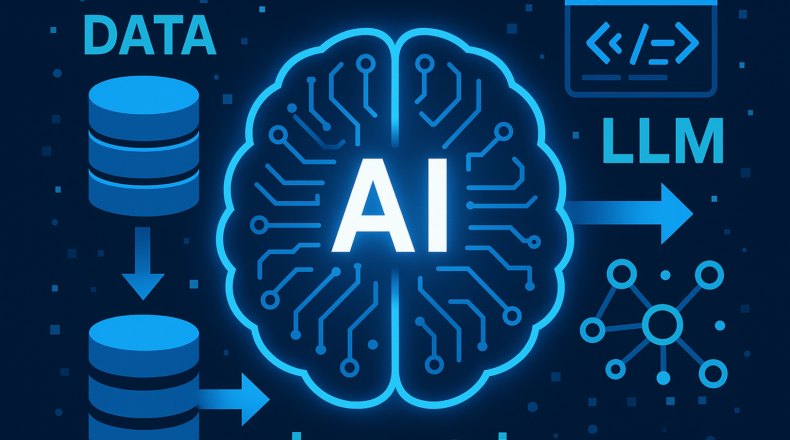
Data → Information → Insights → AI → Better Decisions & Automation
If the left side (data) is broken, everything to the right becomes fragile.
3. What Kind of Data Does AI Need?
Different AI use cases need different kinds of data, but broadly, you’ll see:
-
Structured Data
Tables, rows, columns — typical database content.-
Examples: Customer profiles, orders, transactions, inventory, logs with fixed schemas
-
Used for: Forecasting, churn prediction, scoring, fraud detection, dynamic pricing
-
-
Unstructured Data
Free-form content.-
Examples: Emails, PDFs, contracts, chat transcripts, call center recordings, images, videos
-
Used for: Document search, chatbots, summarization, sentiment analysis, image recognition
-
-
Semi-Structured Data
Flexible formats with some structure.-
Examples: JSON logs, event streams, API payloads
-
Used for: Observability, behavioral analytics, recommendation engines
-
-
Real-Time / Streaming Data
Data coming continuously in small events.-
Examples: Click streams, IoT sensor data, financial ticks
-
Used for: Real-time alerts, live dashboards, adaptive models
-
The more complete, consistent, and connected this data is, the more intelligence your AI can deliver.
4. The Data Lifecycle Behind Successful AI
To make AI actually work in the real world, you need to think about the data lifecycle, not just the model lifecycle.
4.1 Collect: Capture the Right Data
-
Identify what you need to collect to support your AI use case
-
Want to predict churn? You need history of usage, complaints, payments, engagement.
-
Want a legal or policy chatbot? You need well-organized documents and metadata.
-
-
Make sure data is:
-
Logged consistently
-
Timestamped
-
Identifiable (e.g., customer, product, or case IDs)
-
4.2 Store: Choose the Right Homes for Data
Data usually lives in multiple places:
-
Transactional systems (databases backing your apps)
-
Data warehouses (for analytics and BI)
-
Data lakes / lakehouses (for large-scale raw & semi-structured data)
-
Search/vector stores (for semantic search and retrieval-augmented generation)
Key principles:
-
Centralize what matters for analytics & AI
-
Preserve history (don’t overwrite everything!)
-
Ensure performance: queries and model training need reasonable speed
4.3 Govern: Make Data Trusted and Compliant
No governance = chaos.
Governance includes:
-
Data ownership – Who is responsible for each key dataset?
-
Definitions – What does “active customer,” “lead,” or “revenue” actually mean?
-
Permissions – Who can view, update, or export which data?
-
Compliance – Handling personal data safely (PII, GDPR/other regulations)
If people don’t trust the data, they won’t trust the AI — simple as that.
4.4 Prepare: Clean, Transform, and Label
Models don’t like noise. They need:
-
Cleaned data – Handle missing values, duplicates, invalid entries
-
Normalized data – Consistent formats (dates, addresses, units, currency)
-
Linked data – Joining across systems (e.g., customers from CRM + billing + support)
-
Labeled data – For supervised learning, you need correctly labeled examples (fraud/not fraud, positive/negative, approved/rejected, etc.)
For AI with documents and text (LLMs, RAG, chatbots):
-
Organize documents into cases/categories
-
Extract metadata (date, source, tags, jurisdiction, state, product type)
-
Chunk long documents for better retrieval and relevance
5. How AI Becomes Powerful Because of Data
Once the data foundation is in place, AI can do genuinely valuable things.
5.1 Predictive Analytics
With clean historical data, you can:
-
Predict demand, sales, or workload
-
Estimate risk and creditworthiness
-
Forecast failures, delays, or churn
5.2 Recommendation & Personalization
With behavioral and profile data:
-
Recommend products, content, or next-best actions
-
Personalize journeys (marketing, support, onboarding)
-
Improve engagement and satisfaction
5.3 Intelligent Automation
With clear process and outcome data:
-
Automate document classification and routing
-
Auto-extract fields from invoices, contracts, or forms
-
Trigger workflows based on model predictions
5.4 Knowledge & Insights (LLMs + Data)
With well-structured and indexed text data:
-
Build AI assistants for:
-
Policy and compliance
-
Legal research
-
Product documentation
-
IT support & troubleshooting
-
-
Let users ask natural language questions and get answers grounded in your own data, not generic internet content.
6. A Simple Roadmap: From Data Chaos to AI Value
Here’s a practical way to apply “Think Data, Think AI”:
Step 1: Start with a Business Problem
Examples:
-
“Reduce support resolution time by 30%”
-
“Increase qualified leads by 20%”
-
“Cut manual document processing time by half”
Don’t start with “We want AI.” Start with “We want this outcome.”
Step 2: Map the Data You Have (and Don’t Have)
For that problem, list:
-
What data sources exist now?
-
Where are they? Who owns them?
-
What’s missing? (e.g., labels, timestamps, user actions, feedback)
Step 3: Fix the Biggest Data Gaps First
You don’t need perfection on day one. Focus on:
-
The most critical sources
-
The biggest inconsistencies
-
The minimum data quality needed for a meaningful model
Step 4: Build a Small, Focused AI Use Case
-
Keep it narrow but high-impact
-
Use real business data
-
Measure a clear outcome (time saved, accuracy improved, revenue impact)
Step 5: Iterate and Scale
-
Use feedback to refine both the model and the data
-
Add more sources
-
Expand from one use case to a portfolio of AI capabilities
7. Common Pitfalls When You Don’t “Think Data”
If you ignore the “Think Data, Think AI” mindset, you’ll likely see:
-
Cool POC, No Production
Demos that impress leadership once but never become real features. -
Model Performance Degrades Over Time
Because data drifts, pipelines break, or new scenarios weren’t covered. -
Shadow Spreadsheets & Manual Fixes
People quietly export, correct, and re-upload data just to make things usable. -
Ethical & Compliance Risks
AI decisions are challenged because input data was biased, incomplete, or non-compliant. -
Lost Trust
Once users see wrong or unfair outcomes, regaining trust is hard.
8. The Human Side: Building a Data & AI Culture
Technology alone isn’t enough.
To really live “Think Data, Think AI,” you need:
-
Data literacy across teams – People can read, question, and use data confidently.
-
Collaboration between business, data engineers, data scientists, and IT.
-
Clear roles – Data owners, stewards, architects, and AI leads.
-
Feedback loops – Users can report issues or suggest improvements easily.
AI success is a team sport, and data is the shared language.
9. Final Thoughts: Think Data Today to Unlock AI Tomorrow
“Think Data, Think AI” isn’t just a catchy phrase — it’s a strategy:
-
If you invest in your data now, every future AI initiative becomes faster, cheaper, and more reliable.
-
If you skip the data work, you’ll spend your time debugging models that were doomed from the start.
So, next time someone says, “Let’s build an AI for this,”
your first response should be:
“Great. Let’s look at our data.”
That’s where real AI journeys begin.